REVIEW · BUDAPEST
Budapest: Rent a Wide-Wheel E-Scooter
Book on GetYourGuide →Operated by Excelia Tours Kft · Bookable on GetYourGuide
A wide-wheel scooter makes Budapest feel smaller. You get the freedom of a self-guided ride plus quick access to postcard stops like the Hungarian Parliament without the grind of walking everywhere, and it is easy to learn in just a few minutes. The one thing to plan around is range: if you start pushing far beyond the core sights, you may end up with battery trouble before you return.
I especially like how the ride turns planning into choices. You can pause for photos at places like St. Stephen’s Basilica, then keep moving when you feel like it, instead of squeezing everything into a fixed group schedule. And since the scooter is treated like an e-bike, you’ll be able to use bike lanes, which makes the flow through the city feel more natural than you’d expect.
The drawback is practical, not scary: you will be sharing roads with other people, and first minutes can feel a bit busy until you get comfortable. Also, this isn’t for everyone—if you have mobility limitations or you are pregnant, it is not a good fit.
In This Review
- Key highlights worth knowing
- Price and logistics: what you’re really paying for
- Finding the scooter at Bécsi u. 8 (near Deák Ferenc tér)
- What’s included (and what you’ll want to bring)
- How the ride feels in Budapest traffic (and why practice helps)
- Using bike lanes like an e-bike
- The route that makes sense: Parliament to Castle District to views
- 1) Hungarian Parliament Building: start with the headline shot
- 2) Castle Hill: ride, then absorb the atmosphere
- 3) Gellért Hill: panoramic views with less fatigue
- 4) Margaret Island: green time with room to breathe
- 5) St. Stephen’s Basilica: a classic stop for big-city photos
- 6) Heroes’ Square via Andrássy Avenue and City Park
- 7) Chain Bridge: the Danube moment
- 8) Fisherman’s Bastion: end with a postcard payoff
- Timing: 1 hour vs 3 hours changes the whole experience
- Range and battery reality: don’t take the scenic detour too far
- Safety and comfort: helmets, gloves, and “go slow first”
- Who this is best for (and who should skip it)
- Eco-friendly factor: quieter city time
- Should you book this Budapest MonsterRoller rental?
- FAQ
- How long is the Budapest MonsterRoller rental?
- Where do I meet the scooter?
- Is a driving license required?
- What’s included with the rental?
- What should I bring and what is not allowed?
- Is it suitable for everyone?
Key highlights worth knowing
- Bike-lane friendly: It qualifies as an e-bike, so you can ride where traffic flows better for cyclists.
- Quick practice curve: A few minutes is usually enough to feel confident and start focusing on sights.
- Big views on a simple route: Gellért Hill, Buda Castle areas, and Fisherman’s Bastion are built for photo stops.
- Flexible pacing: Stop for coffee, photos, or a snack whenever you want during your rental window.
- Safety gear included: Helmets come with the rental, plus gloves and a rain poncho when needed.
Price and logistics: what you’re really paying for

At about $30 per person for 1–3 hours, this is not “cheap” in the way a metro ticket is cheap. But it is good value for what you get: private, self-guided movement that lets you cover more of central Budapest without hauling yourself up and down hills on foot.
Think of it as time-buying. Budapest’s highlights are close together on a map, but they can feel far apart when you’re walking, especially once you factor in photo stops and the Castle District terrain. A wide-wheel e-scooter helps you make those gaps disappear, so you can spend your energy enjoying the city rather than saving it for the next steep street.
You don’t need a driving license. You do need ID (passport or an ID card). And you need basic common sense: no alcohol or drugs, and bare feet aren’t allowed.
Finding the scooter at Bécsi u. 8 (near Deák Ferenc tér)
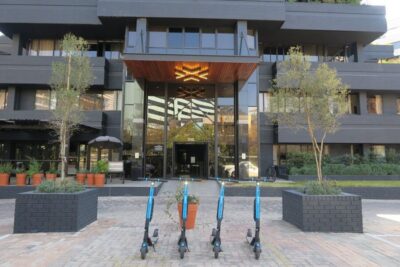
Your starting point is Bécsi u. 8, with scooters in front of the store and an E-Magine sign to look for. It is about a 2-minute walk from Deák Ferenc tér metro (lines M1, M2, M3).
This matters because Budapest works best when you’re not guessing transportation. If you arrive at Deák Ferenc tér, you’re already in the center of the city’s grid. You can either reach your pick-up quickly, or even adjust your plan on the fly if you’re running a little late.
What’s included (and what you’ll want to bring)
Included gear makes a real difference on a scooter rental. You get:
- Helmets
- A lock
- Gloves in cold weather
- A rain poncho depending on conditions
What’s on you:
- ID (passport or ID card)
- Comfortable clothing and closed-toe footwear
- Any snacks or drinks you want during your stops (those aren’t included)
I like this setup because it removes the “did we remember the basics?” stress. The gloves and poncho part is especially useful in shoulder seasons when Budapest can swing from sunny to windy and chilly fast.
How the ride feels in Budapest traffic (and why practice helps)
A key point is how quickly you can learn. The scooter needs only a few minutes to get the hang of it, even if it’s your first time. The wide-wheel design also helps you feel steadier at low speeds and during small course corrections.
Your first challenge is not speed. It is awareness:
- You are moving faster than walking.
- You may be riding near cars at junctions.
- You’ll want to watch for pedestrians stepping out or slowing down suddenly.
Once you settle into a rhythm, it becomes fun fast. I’d treat the first 10–15 minutes as your warm-up, then start aiming for the viewpoints.
Using bike lanes like an e-bike
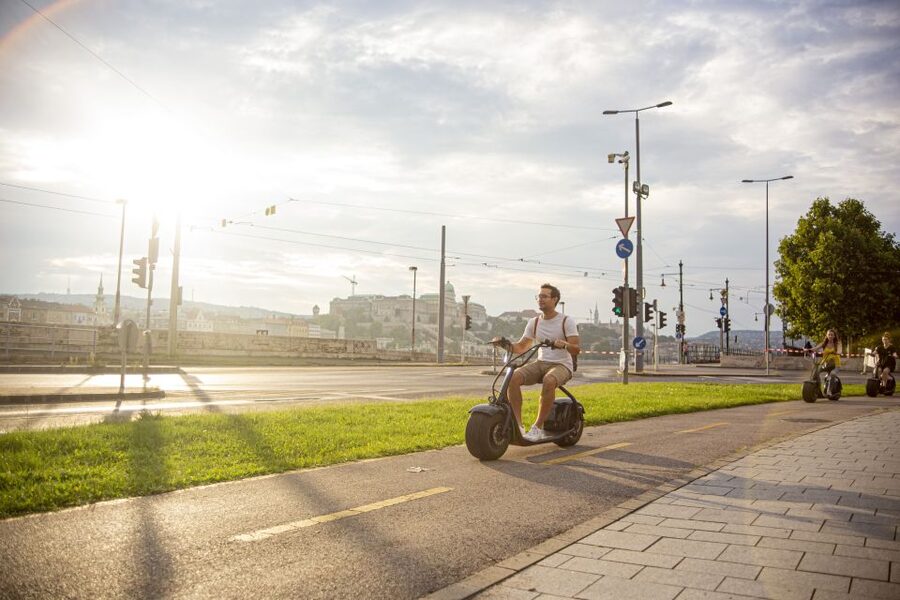
This scooter is described as qualifying as an e-bike. That’s more than a technical detail—it usually translates to better routing options. In practice, it means you can look for bike lanes and calmer corridors rather than fighting the chaos of the widest car lanes.
This is also why the self-guided style works so well. You can adapt your route based on what feels easiest in the moment, instead of following a script you can’t change.
The route that makes sense: Parliament to Castle District to views
The rental doesn’t give you a guided narration, so your best plan is to think in “photo clusters” and “view clusters.” The route below hits both.
1) Hungarian Parliament Building: start with the headline shot
You’ll stop by the Hungarian Parliament Building for photos. This is a strong opener because it’s a clear landmark and it puts you right into the Danube-side drama.
Practical tip: treat this as your first “slow down and look around” moment. Once you’re moving, you’ll want to keep your eyes up for vehicles and crossings.
2) Castle Hill: ride, then absorb the atmosphere
From there, you head toward Castle Hill and spend time visiting and riding around. The Castle District is where Budapest starts stacking the views and the walkable streets feel more medieval and compact.
The scooter helps, but it does not replace the walk entirely. Expect to walk a little when you want to explore side streets or step into viewpoint areas where you might not want to ride right up to the edge.
3) Gellért Hill: panoramic views with less fatigue
Gellért Hill is on the route for sightseeing. This is one of those “you’ll remember the view later” spots, and the scooter gets you there without burning your legs climbing on foot.
If you’re only doing one or two hours, this is one of the stops I would prioritize because the payoff is big: wide sightlines over the river and city. Plan to spend a few minutes just standing still too, not only taking photos.
4) Margaret Island: green time with room to breathe
Next comes Margaret Island. It’s a great breather after the stone-and-stair energy of central sights. You’ll have free time here while still enjoying the ride.
What makes it worthwhile is the contrast. Instead of another major landmark, you get gardens, fountains, and quieter medieval ruins. Even if you don’t go deep into every path, the island setting gives you a reset.
This is also where I’d slow down. Pedestrian traffic can be thicker on islands and promenades, so keep your speed modest and be extra predictable.
5) St. Stephen’s Basilica: a classic stop for big-city photos
You’ll make a photo stop at St. Stephen’s Basilica. This is a perfect “snap and move” kind of stop because the building reads well from multiple angles and it’s easy to blend into a broader route.
Keep your timing flexible. If the area is crowded, you can still find photo angles without needing to squeeze close.
6) Heroes’ Square via Andrássy Avenue and City Park
To reach Heroes’ Square, you’ll ride via Andrássy Avenue, plus the quiet stretch of City Park. Andrássy Avenue is the showy approach, while City Park adds breathing room before the monument area.
This is a good section to enjoy the motion. It is less about one single photo and more about the feeling of progressing through the city’s different moods.
7) Chain Bridge: the Danube moment
Then comes the Chain Bridge for sightseeing and scooter riding. This is where you get that Budapest “centerline” feeling, the axis between sides of the river and the dramatic view lines.
Practical note: bridges can be busy. Keep your control smooth and your stops deliberate.
8) Fisherman’s Bastion: end with a postcard payoff
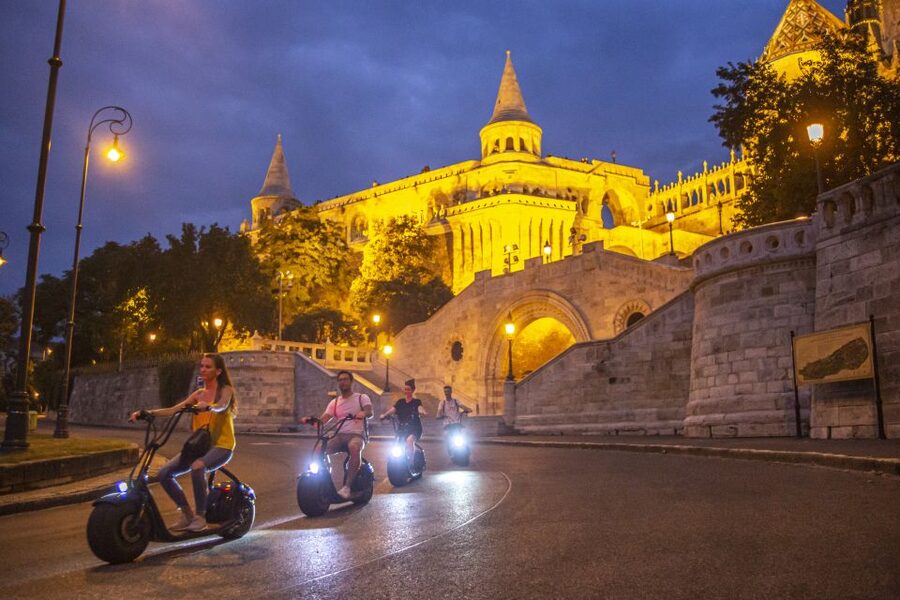
Finally, you’ll stop at Fisherman’s Bastion for photos and sightseeing. This place is built for viewpoints. Even if you only have a short window, it can feel like your biggest payoff because the angles are obvious and the photos look good fast.
If you’re aiming to maximize your time, this is the stop where you should not rush. Give yourself 15–20 minutes to wander and find your preferred viewpoint.
Timing: 1 hour vs 3 hours changes the whole experience
The rental is 1–3 hours, and that difference really matters.
A short rental (around 1 hour) works best if you focus on a tight loop: one major landmark, one viewpoint, then a second landmark. You’ll still be mobile, but you will be more “hit the highlights” than “wander.”
A longer rental (closer to 3 hours) gives you the breathing room that Budapest sightseeing needs. One useful detail from real-life experience: people sometimes wish they had chosen the full time budget, especially if they want to reach the Castle District without feeling rushed.
If you choose 2–3 hours, you can also add a little slack for crowds and junctions. That is often what makes the difference between an enjoyable ride and a sprint to the meeting point.
Range and battery reality: don’t take the scenic detour too far
Here’s the one caution I’d underline. The scooter’s battery/range can be limiting if you ride too far off the core route or keep pushing the far side of the city before turning back.
In my view, this is not a dealbreaker. It just means you should use detours like seasoning, not like the whole meal. If you want to wander, do it around the main sights and viewpoints, then work your way back early enough to avoid stress.
If you do feel you’re running long, it’s better to reduce detours than to hope for a miracle battery recovery.
Safety and comfort: helmets, gloves, and “go slow first”
Safety gear is included, and that’s a good sign. Helmets are provided, and gloves and a rain poncho show up when conditions call for it. I’d treat those as part of your “comfort plan,” not an afterthought.
Also, don’t ignore fit and footwear. The rules say no bare feet, so wear closed-toe shoes you can stand on comfortably. Then ride like a human, not a toy: smooth starts, predictable stops, and extra caution when crossing or threading through busy pedestrian areas.
And keep an eye on your own expectations. You will likely start out feeling awkward near traffic. Then you get it. After that, the scooter becomes pure fun.
Who this is best for (and who should skip it)
This is a strong choice if you:
- Want to move fast between major sights
- Like choosing your own stop times
- Enjoy viewpoints and photo breaks
- Want an eco-friendly, quiet way to explore
It’s not a good match if you:
- Are pregnant
- Have mobility impairments
And if you’re hoping for a relaxed, sit-back guided tour experience with a narration, this is self-guided. You are the decision-maker here.
Eco-friendly factor: quieter city time
The scooter is described as zero-emission and quiet. In Budapest, where central streets can feel loud and heavy, the quieter travel mode is part of the charm. It also keeps you from dealing with constant congestion friction.
Again, think of it as more than “green.” It is also a more pleasant way to move through tight spaces because it’s less intrusive than a motorcar and typically easier to control.
Should you book this Budapest MonsterRoller rental?
Book it if you want an efficient, fun way to hit key sights like Parliament, St. Stephen’s Basilica, Heroes’ Square, Chain Bridge, and Fisherman’s Bastion without spending half the day walking. The included helmet, lock, and weather gear reduce hassle, and the quick learning curve makes it easy to start enjoying the city fast.
Skip it if you strongly prefer walking for its own sake, or if you need a fully guided, narration-based experience. And if battery anxiety worries you, plan a mostly central route and turn back with time to spare.
FAQ
How long is the Budapest MonsterRoller rental?
It runs for 1–3 hours, depending on the starting time you choose.
Where do I meet the scooter?
You’ll find the scooters at Bécsi u. 8, in front of the store with an E-Magine sign. It’s about a 2-minute walk from Deák Ferenc tér metro station (M1, M2, M3).
Is a driving license required?
No driving license is needed.
What’s included with the rental?
Helmets and locks are included. Gloves are provided in cold weather, and a rain poncho is provided depending on the weather.
What should I bring and what is not allowed?
Bring a passport or ID card. Alcohol and drugs are not allowed, and bare feet are not allowed.
Is it suitable for everyone?
It is not suitable for pregnant women or people with mobility impairments.